I recently wrote a short story for the upcoming Hot July Days event at the Goodreads M/M Romance Group. Readers posted pictures and letters as prompts for authors in the group to write short stories. My story is just over 8,000 words in length, and I must have read it ten or more times as I was revising and proofing.
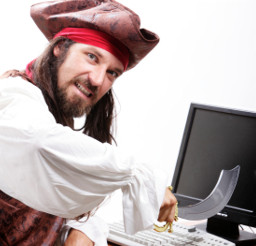 Even in this short of a story and even after reading it over so many times, I missed a couple of obvious typos. My partner read it the other night and pointed them out. I had written “reprehension” for “representative” and “me nipples” for “my nipples.” For that last one she said I had gone into pirate mode, and then she went around the house repeating, “Arrr! Lick me nipples” all night.
That wasn’t the reaction I was going for. A typo like that can really pull the reader out of the moment.
When submitting to a publisher, writing a free read for your website, or polishing any professional piece of written work, I think it’s important to have someone else read it over, at the very least to check for these sorts of typos. No matter how careful you have been in your own proofing you are likely to miss something, and your work will look less professional with each mistake.
I do realize this may not be possible for everyone or every situation, so I thought I’d share three techniques that have worked to help me catch more of my own mistakes.
- Make the font size larger and the margins smaller, then print the text out. You’ll see the words in a very different way from how you’ve been viewing them as you wrote and revised the text. You could also try loading it on an eBook reader to get yet a different view.
- Read your words aloud. It slows down the flow of words, and I can catch more mistakes that way. I find standing up and walking around helpful too. Not only is this a good idea for us writers who sit a lot of the time, but I also find the act of moving and being in a different location than where I originally wrote the story helps to mix things up for my brain. (On a side note, I believe reading aloud also helps you create, maintain, and strengthen your own voice.)
- Have the computer read the text to you. This works great to identify a misspelling that the spell checker won’t catch. For example, my mistake of “me nipples.” Even with a choppy computerized voice, I would have definitely heard the computer read the “me” instead of the “my” that I had meant. For a short story this works great, but it can take a lot of time for something longer and may not be feasible if you’re under a deadline. I use Adobe Acrobat or my Kindle for this. You could also search for “text to speech software” for other options.
What do you think? Are you bothered by typos or can you keep on reading without much distraction? Anyone else have another proofing tip that works for you? I’d love to hear about it.
Sloan Parker
www.sloanparker.com


14 comments:
Typos drive me crazy! Proofing is essential. Great suggestions all! :)
I've never read any of my manuscripts aloud; it would take too long and give me a sore throat...and might perk up the neighbours a bit TOO much if they overheard, given my genre... ;)
What I do is embiggen (that's a real word) the font, save the document as an .RTF and shunt it over to my ereader, where I give it the last once-over. I highlight any typos, then correct on the MS Word laptop version.
Errors like that always throw me for a while, although lick me nipples would have given me a good giggle. It's so easy to just see what you expect to see, isn't it?
I think the best typo still has to be "a massive fish crashed into his jaw" from The Why Not.
Oh dear... Pirate-mode totally made my day just now. Good thing you have a pre-reader at home like that. :)
Good tips, though. I, as a non-english speaker actually have a problem with thinking about a word and writing something completely different. Like say, I want to write "considerate" I might actually write "contemplate" or the likes. And it's not that I don't know the words, it's just that my fingers seem to think it's cool to write something else that has the same beginning.
Luckily I catch those words immediately, often going "Duh...so not what I was supposed to write...". I actually think it's about my fingers finding the most familiar word from my vocabulary, taking the most used route on my keyboard after the beginning of the word matches... Sensory memory or something...
My biggest problem is becoming blind to my own writing REALLY fast. That's why my beta-readers have their hands full most of the time... At the moment I'm going through the galley proof of my July-novella, and I'm honestly thinking I have to concentrate concentrate concentrate, because otherwise I'll miss if there's anything to correct in it. Meh.
Good points well made, Sloan. I'm with Tia--blind to me own mistooks, but I notice them when I'm reading published stories and they are turn-offs--unless they're funny....
Thanks, Damon. It’s frustrating when you actually put the time into doing as thorough a review as you can and still miss something like I did. Which just shows how helpful it is for me to have another set of eyes looking it over.
Oh Scarlett, that’s funny. I have wondered what my neighbors would think if they saw me through the window walking around my house reading to myself, but I guess I should have worried more about what they would think if they actually heard me. Good idea to highlight the typos on your reader. Thanks for sharing.
Juni, that’s a great example.
My sweetie’s laughter over the nipples typo was not the reaction I’d wanted in that scene, but she was having fun so I guess that’s better than a reader finding it later.
Tia, glad you got a kick out of my pirate slip-up. You know I think I do something similar with my fingers typing their own thing. If there’s a word that I’ve typed wrong over and over, it’s hard to break that bad habit.
I'm impressed that you can catch those as you go. My brain is already on to the next thing and I only see it later. Congratulations on the upcoming novella!!
Thanks, Evanne! The funny ones are probably less annoying but I'm sure still pull readers out of the story, especially if it's high drama at the time. :) I've seen many writers offer the advice of putting a manuscript in a drawer and forgetting about it for as long as possible, then read it fresh. I wish I had the time to do that for more than a week or two.
Yep, typos throw me every time. One or two get a free pass, but when characters names start changing? That story's lost me.
Good tips, Sloan. I think the computer voice would drive me insane in three seconds flat, though. ;-)
Hi LC. Thanks for stopping by. Changing character names is one typo where another person looking it over would be a big help. Maybe the author had more than one project going on and they typed the wrong name, or they changed a name after the first draft. Since the "wrong" name is familar to them, it may not stand out as much as it would someone new to the story.
You know, I'm surprised at how fast I get used to listening to the computer voice. And the Kindle's text to speech is really not too bad, for a computer.
It really bothers me when I find typos, especially, because that is one of my pet peeves. I recently read a book where they spelled the main characters name wrong and I couldn't stop thinking about that typo until the end of the chapter! So, yeah, it majorly distracts me!
Hi Laurie. That would be one typo that would stick out for sure. Just shows how important it is for a publisher to have careful copy editors and proof readers.
Thanks for taking the time to comment.
Post a Comment